


Die meisten Unternehmen setzen die Anforderungen der österreichischen Registrierkassenpflicht zu Beginn korrekt um. Die eigentlichen Herausforderungen entstehen häufig erst Monate oder Jahre später im laufenden Betrieb
Mit der Inbetriebnahme eines neuen POS Systems in Österreich werden die gesetzlichen Anforderungen in der Regel ordnungsgemäß umgesetzt. Das System wird in FinanzOnline registriert, die Signaturkarte wird aktiviert, Belege werden ordnungsgemäß signiert und die Fiskalisierungs Middleware ist eingerichtet. Diese initiale Einrichtung stellt selten das Problem dar.
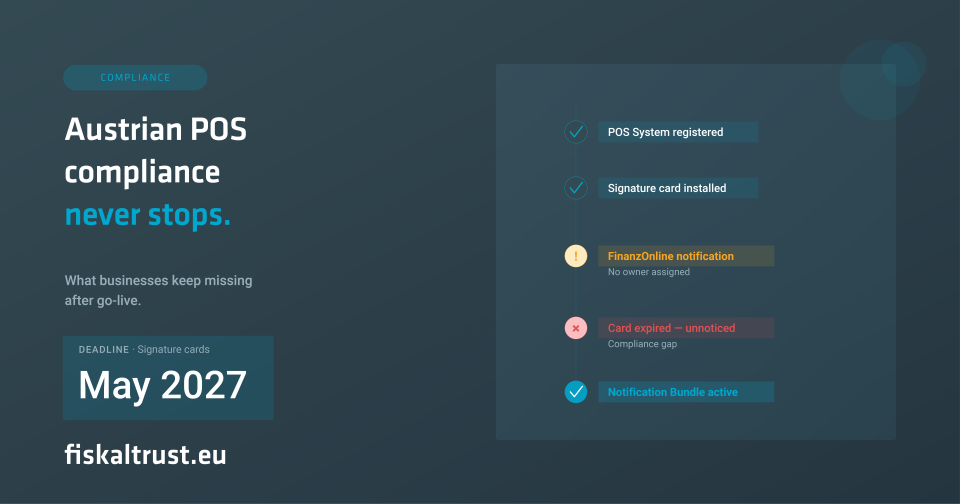
Die Schwierigkeiten entstehen später. Oft in Form einer Frist, für die keine klare Zuständigkeit definiert ist, einer abgelaufenen Signaturkarte oder einer verpflichtenden FinanzOnline Meldung, die zwischen POS Händler und Unternehmer nicht eindeutig zugeordnet wurde. Wenn ein solcher Sachverhalt bemerkt wird, hat er sich häufig bereits zu einem operativen Problem entwickelt, anstatt eine planbare Routineaufgabe geblieben zu sein.
Um zu verstehen, weshalb solche Situationen regelmäßig auftreten, ist ein Blick auf die laufenden Verpflichtungen des österreichischen Fiskalrechts erforderlich.
Was das österreichische Recht über die Erstinbetriebnahme hinaus verlangt
Seit Einführung der Registrierkassenpflicht und des RKSV Rahmens sind Unternehmen verpflichtet, eine Reihe von Anforderungen dauerhaft einzuhalten. Die Registrierung über FinanzOnline ist lediglich der erste Schritt. Darüber hinaus verlangt das Gesetz unter anderem die Meldung von Sicherheitseinrichtungen, die ordnungsgemäße Verwaltung von Signaturkarten und Sicherheitseinrichtungen, die Dokumentation von Ausfällen, die Meldung von Systemänderungen sowie die korrekte Archivierung von Belegen über die gesamte Betriebsdauer des Systems.
Keine dieser Anforderungen ist isoliert betrachtet besonders komplex. Die Herausforderung liegt vielmehr darin, dass diese Verpflichtungen wiederkehrend sind, feste Fristen aufweisen und organisatorisch zwischen zwei Parteien angesiedelt sind. Der POS Händler betreut das System technisch, während der Unternehmer die rechtliche Verantwortung trägt. Fehlt eine klare und verbindliche Aufgabenverteilung, entstehen Lücken im Prozess.
Mit zunehmender Anzahl an Standorten steigt das Risiko deutlich. Ein einzelner Betrieb kann viele dieser Aufgaben noch manuell verwalten. Ein POS Händler, der 50 oder 100 Standorte betreut, jeweils mit eigenen Sicherheitseinrichtungen und individuellen Meldezyklen, steht vor einer deutlich komplexeren Situation.
Compliance Risiken im laufenden Betrieb
Im operativen Alltag entstehen Compliance Probleme häufig durch scheinbar kleine Versäumnisse. Eine Signaturkarte erreicht ihr Ablaufdatum, ohne rechtzeitig ersetzt zu werden. Der Status einer Sicherheitseinrichtung ändert sich, die entsprechende Information wird jedoch nicht an die zuständige Person weitergeleitet. Eine FinanzOnline Meldung ist fristgerecht erforderlich, aber es ist unklar, wer sie durchführen muss.
Die Folgen können finanzieller Natur sein, häufig sind sie jedoch zunächst operativ spürbar. Arbeitsprozesse müssen unterbrochen werden, Dokumentationen sind zu prüfen, Verantwortlichkeiten sind zu klären. Zeit, die für das Kerngeschäft vorgesehen ist, wird für die Behebung eines vermeidbaren Compliance Sachverhalts eingesetzt.
Besondere Aufmerksamkeit verdient aktuell eine konkrete gesetzliche Frist. Sämtliche derzeit in Österreich eingesetzten Signaturkarten müssen spätestens bis Mai 2027 ersetzt werden. Für Unternehmen und POS Händler mit mehreren Standorten handelt es sich dabei nicht um eine einzelne Maßnahme, sondern um ein Projekt, das frühzeitig geplant und strukturiert umgesetzt werden muss.
Der Informationsfluss als zentrale Herausforderung
Gemeinsam ist all diesen Konstellationen nicht ein technisches Versagen. Die POS Systeme funktionieren in der Regel ordnungsgemäß. Das Kernproblem besteht vielmehr darin, dass relevante Informationen nicht zur richtigen Zeit bei der richtigen verantwortlichen Stelle ankommen.
Ein Compliance Ereignis, das zwei Wochen vor Fristablauf erkannt wird, stellt eine planbare Aufgabe dar. Dasselbe Ereignis am Tag vor Ablauf der Frist entwickelt sich zu einer operativen Krise. Der Unterschied liegt nicht in der technischen Leistungsfähigkeit des Systems, sondern in der Existenz eines verlässlichen und strukturierten Prozesses zur frühzeitigen Identifikation relevanter Ereignisse.
Für POS Händler mit einer Vielzahl betreuter Standorte ist dieser Aspekt besonders kritisch. Eine versäumte FinanzOnline Meldung an einem Standort betrifft nicht nur den jeweiligen Unternehmer, sondern wirkt sich auch unmittelbar auf die Servicequalität und Reputation des POS Händlers aus. Werden Benachrichtigungen nicht manuell nachverfolgt, sondern als strukturierter Prozess organisiert, verändert dies die operative Verantwortung grundlegend.
Wie das fiskaltrust Notification Bundle diese operative Lücke schließt
Das fiskaltrust Notification Bundle ist als Abonnementmodell konzipiert und adressiert gezielt diese operative Schnittstelle. Es überwacht compliance relevante Ereignisse im POS Umfeld und deckt zwei besonders fehleranfällige Bereiche ab: ereignisbasierte FinanzOnline Meldungen sowie das Lebenszyklus Management von Signaturkarten.
Im Bereich der Meldungen überwacht das fiskaltrust Portal die fiskalischen Ereignisse des Kassensystems und übermittelt erforderliche Meldungen automatisiert an FinanzOnline. Eine manuelle Einreichung oder separate Fristenüberwachung durch den Betreiber ist nicht erforderlich.
Im Bereich der Signaturkarten beinhaltet jedes Abonnement eine fiskaltrust Karte, eine zertifizierte Signaturkarte nach dem ACOSID 4.1 Standard, produziert von Austriacard. Nach zwölf Monaten ist eine Ersatzkarte im Leistungsumfang enthalten. Ebenso ist ein Austausch bei Defekten oder Zertifizierungsänderungen vorgesehen. Auch die gesetzlich vorgeschriebene Erneuerung bis Mai 2027 wird innerhalb des regulären Abonnementzyklus berücksichtigt.
Der Preis beträgt 74 Euro pro Kasse und Jahr. Für POS Händler bedeutet dies, dass aus einer Vielzahl einzelner Compliance Verpflichtungen ein strukturierter, wiederkehrender Service wird. Für Unternehmer bedeutet es, dass die gesetzlichen Anforderungen erfüllt werden, ohne dass sie operative Detailprozesse eigenständig steuern müssen.
Compliance ist ein fortlaufender Prozess
Die österreichische POS Compliance endet nicht mit der Installation eines Systems. Die gesetzlichen Anforderungen erfordern eine kontinuierliche organisatorische Aufmerksamkeit. Die meisten Risiken entstehen nicht durch komplexe technische Fehler, sondern durch alltägliche Ereignisse wie den Ablauf einer Signaturkarte, eine erforderliche Meldung oder eine Systemänderung, die nicht rechtzeitig erfasst wurde.
Die Umstellung von manueller Einzelüberwachung auf einen strukturierten, gemanagten Prozess reduziert Risiken, erhöht die operative Stabilität und schafft klare Verantwortlichkeiten innerhalb des gesamten POS Ökosystems.
Weitere Informationen zum Notification Bundle finden Sie unter:
English Version
Austrian POS compliance is not a one-time setup. Here is what businesses keep missing.
Most businesses set up Austrian cash register compliance correctly at the beginning. The challenges usually appear months or years later during ongoing operation and maintenance.
When a new POS system goes live in Austria, someone usually handles compliance properly. The system gets registered with FinanzOnline, the signature card is in place, the receipts are signed and the fiscalisation middleware is running. That first step is rarely the problem.
The problem tends to arrive later, quietly, in the form of a deadline that nobody owns, a card that expired without anyone noticing, or a required FinanzOnline notification that fell through the gap between the POS dealer and the merchant. By the time the issue arises, it has already become an operational problem rather than a routine task.
Understanding why this keeps happening requires a closer look at what Austrian fiscal law actually asks of businesses on an ongoing basis.
What Austrian law requires beyond the initial setup
Since the introduction of mandatory cash register regulations and the RKSV framework, Austrian businesses have been required to meet a set of obligations that do not stop when the POS system is first switched on. Registration via FinanzOnline is just the beginning. The law also requires notification of security devices, proper management of signature and security cards, documentation of outages, reporting of system changes and correct archiving of receipts throughout the system’s operating life.
None of these are technically complex in isolation. What makes them difficult is that they are recurring, they have fixed deadlines and they sit at the intersection of two different organisations, namely, the POS dealer who manages the system and the merchant who owns the compliance obligation. When it is not clear who is responsible for what, things get missed.
This matters more as the scale increases. A single-location business can manage most of this manually. A POS dealer supporting 50 or 100 merchant locations, each with its own devices and notification schedule, is dealing with a different problem entirely.
Compliance risks that become real
In daily operation, the compliance issues that cause disruption are usually small things. A signature card reaches its renewal date without anyone noticing. A security device changes status and the alert goes to the wrong inbox. A FinanzOnline notification is due, but nobody knows who is responsible, so it gets delayed.
The consequences are not always financial, though they can be. More often the immediate cost is operational. Someone has to stop what they are doing to investigate. Documentation needs to be reviewed. The responsible party has to be identified. Time that should go into running the business is spent fixing a compliance issue that earlier notice could have prevented.
There is also a deadline that deserves specific attention right now. All signature cards currently in use in Austria must be replaced by May 2027. For businesses and POS dealers managing multiple locations, that is not a single task. It is a project and it requires planning well in advance of the deadline.
Information flow is the actual problem
What connects all of these scenarios is not a failure of technology. The POS systems are generally working as they should. The issue is that the right information does not reach the right person at the right time.
A compliance event that is flagged two weeks in advance is a task. The same event flagged the day before the deadline is a crisis. The difference between those two outcomes is not technical capability. It depends on whether a reliable process exists to identify issues early. For POS dealers managing many merchants, this matters even more. A missed FinanzOnline notification at one location affects the dealer’s service reputation, not only the merchant’s compliance. Turning notifications into a managed process instead of manual tracking changes how this responsibility is handled
How the fiskaltrust Notification Bundle addresses this
The fiskaltrust Notification Bundle is a subscription product built specifically to close this operational gap. It monitors the compliance relevant events in a POS environment and addresses the two recurring obligations that most frequently cause disruption: event-based FinanzOnline notifications and signature card lifecycle management.
On the notification side, the fiskaltrust Portal monitors fiscal activity and submits the required notifications to FinanzOnline based on events generated by the cash register system. There is no manual filing and no separate deadline to track.
On the card side, each subscription includes one fiskaltrust card, a certified signature card based on the ACOSID 4.1 standard, produced by Austriacard. A replacement card is included after twelve months and also in the event of card defects or certification changes. The May 2027 replacement requirement is handled within the regular subscription cycle.
The subscription is 74 euros per cash register, per year. For POS dealers, it converts a fragmented set of compliance responsibilities into a recurring managed service. For merchants, it means the obligations are handled without requiring active involvement in the details.
Compliance is continuous. The processes around it should be too.
Austrian POS compliance does not end at installation. The regulations require ongoing attention, and the operational consequences of missing a deadline are real. Most of the risk does not come from complex technical failures. It comes from ordinary events, a card renewal, a required notification, a system change, that nobody was tracking closely enough.
Turning compliance into a managed process reduces risk, protects operational stability and clarifies responsibility across the POS ecosystem.
More information about the Notification Bundle: